
I begin by imagining something surprising and important, a question whose answer is not clear to me, but seems vital. Questions like: How do we balance the needs of the individual with the needs of the community, when they’re in conflict? (That became Pigs in Heaven.) How does one make peace with the terrible things one country does to another, when we’ve profited from them but weren’t responsible? (The Poisonwood Bible.) I begin to plot out a story in which characters will face these questions through some conflict or crisis. I write pages and pages of what this novel will be about. Themes, plot, characters. I create life histories for the characters. I list the things I’ll need to research, in order to tell this story. As scenes occur to me, I jot them down without worrying about chronology. The beginning and the resolution will come, once I understand the architecture of the story.
I spend months or years thinking about the shape of a novel and earning the authority to write it. Samuel Johnson wrote, “a man can turn over a whole library to write a single book,” and I would add, you also have to wear out some shoe leather. (See the question about primary and secondary research.) I usually keep a novel cooking on the back burner for a long time, before it moves up front. During this time I accept magazine and newspaper assignments that keep me writing while a novel is in the research and development phase. Once I begin writing the novel in earnest, the early challenge is to find the voice and tone. I throw away hundreds of pages before I find that; my best writing tool is the Delete key. I think of it as writing pages minus-100 to zero of my novel, just a necessary evil. I have to write them all, and pitch them out.
I struggle with confidence, every time. I’m never completely sure I can write another book. Maybe my scope is too grand, my questions too hard, surely readers won’t want to follow me here. A novel is like a cathedral, it knocks you down to size when you enter into it. I falter and fidget and worry it won’t be good enough, and then the day comes when I give myself permission: just write, I tell myself. No one has to see it, you can throw everything away if it’s terrible, we’ll keep it a secret unless or until it becomes wonderful. And then I get to work.
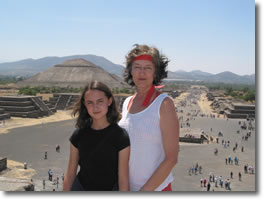 Hooray for you, for knowing the difference between primary and secondary sources, in a world where many seem to think watching a nature show is the same thing as being in nature. It isn’t. The nature show leaves out the smells, for one thing, and the seventeen hundred hours the camera crew sat waiting for the rhinos to mate. Another person’s account of a place — whether it’s Henry Thoreau or Youtube — is only part of the story.
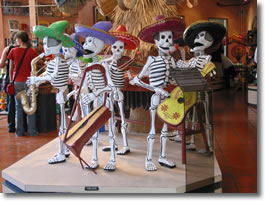 It raises questions I’ve wondered about for nearly as long as I’ve been a writer, starting with this one: Why is the relationship between art and politics such an uneasy one in the U.S.? Most people in other places tend to view these as inseparable. Mexico, for example, has historically celebrated its political artists as national heroes, but here that combination can make people nervous, to put it mildly. We seem to have an aversion to national self-criticism in general. We began as a nation of rabble-rousers, bent on change. But now, patriotism is often severely defined as accepting our country to be a perfect finished product. As in, “Love it or leave it!”
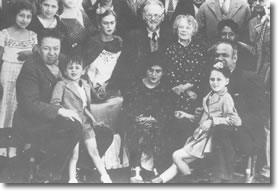 Frida and Diego are relatively minor players who received a disproportionate amount of the review attention, probably because it made for good artwork on the Sunday Arts section of the newspaper. But that’s not why I included them. When I construct a novel, I back up from “effect” to “cause.” I wanted to examine the modern American political psyche, using artists as a vehicle. My protagonist would be singled out because of his suspect past, so I had to give him a past. It made sense for many reasons to start with the Mexican revolutionary muralists of the 1930’s, and end with the anti-communist censorship of the 1950’s. I would track the contrast, as Mexico’s attitudes about political art diverged from those in the U.S. I initially thought of these figures as setting rather than character, part of the novel’s grounding in historical fact.
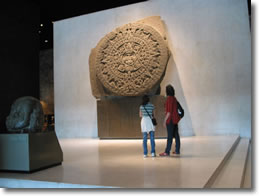 Both. Fortunately, I like research. I was trained as a scientist, and tend to approach tasks methodically, enjoying what I learn along the way and trying to use it resourcefully. Sometimes I did feel I was trying to move a mountain with a teaspoon. I read many books about U.S. and Mexican history just to find my starting point. Month by month, I circled in to frame the story in theoretical terms. And that was only the beginning. A novel is made of details. Every character, on every page, has to be immersed in a perfectly visualized scene: using transportation, cooking, listening to radio programs, speaking in the particular jargon of an era. Wearing clothes. (Unless they aren’t, but that can’t last long.) Each detail has to be historically exact, and in this case “the era” involved dozens of different locations in two countries, crossing nearly thirty years.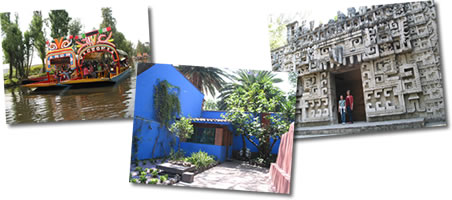
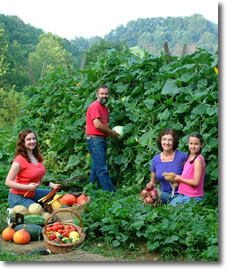
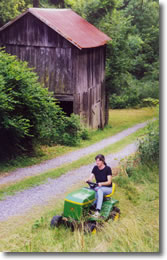 We’re a pretty ordinary family, in that we all have a thousand things to do including full-time jobs or school. Part of the point we wanted to make in Animal, Vegetable, Miracle is that regular, busy people can pay more attention to where our food comes from, and use healthier ingredients for the rituals of our lives. All over the world, people have food cultures, cooking special meals on various occasions (or even every day) because it’s traditional, enjoyable, and considered to be worth the effort. In this country, the closest thing we have to a distinctive food culture might be feeding our kids burgers in a speeding car. Are we busier than families in Italy or Japan?
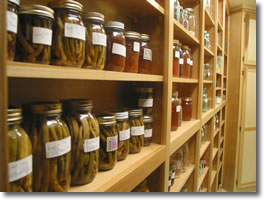 It was a deeply enjoyable conversion, so yes, it did stick. We still organize our meals around what’s locally available, when it comes into season. We don’t eat industrially-produced feedlot meats, and frankly can’t imagine it. Our garden expands every year, and our local farmer’s market also keeps growing. We buy extra fruits and vegetables when they come into season, and freeze or can them so we’ll have abundance (and easy meals) in winter. We’ve become friends with the farmers who work so hard to provide us with everything that helped make our “year of local” so delicious – why would we turn our backs on them now? It’s not just a matter of health and epicurean pleasure, but also community responsibility, for us to stay involved in our local food chain.
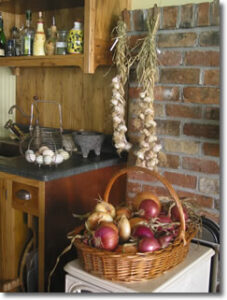 Thoughtful food life is not just about growing your own. Anybody who has choices about food can exercise them with more care. Every grocery store carries some things that were produced closer to your home than the backside of yonder. Anyone can emphasize whole ingredients in their meal plans, and pass up the processed junk that has so many costs wrapped up in the package. And the majority of U.S. citizens live within a few miles of a farmers’ market. In fact, these are much more concentrated in and around cities than in rural places. The fastest-growing sector of the U.S. agricultural economy is the small market grower producing food for urban consumers. City dwellers might be surprised to learn that rural America has fewer farmers’ markets per capita, and the hardest place of all to find local foods is the Midwestern corn-and-soybean belt. It’s a sad commentary on our agricultural system that the bulk of our farm produce is essentially inedible.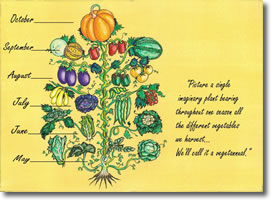
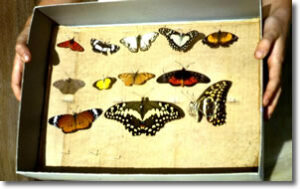 I’ve been trained as a biologist, more or less from the beginning. I grew up chasing butterflies, went to graduate school in Ecology and Evolutionary Biology, and still look at the world through the eyes of a scientist, I suppose. Leaving the halls of science for the world of literature and the humanities was like jumping across the Grand Canyon: I can plainly see a great divide that exists between two kinds of thinking. I wanted to write a novel to bridge that gulf somehow. Specifically, I wished I could explain a handful of important ecological principles: speciation and natural selection, the keystone predator, genetic diversity and resilience, and the Volterra principle, which (for instance) shows mathematically why spraying a field with pesticides actually will increase the number of pests in the next generation. These principles profoundly shape the world around us, in which we hope to survive.
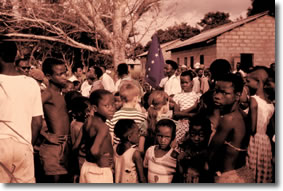 This story came from a long-term fascination with politics and culpability, and my belief that what happened to the Congo in 1961 is one of the most important political parables of a century. I’d thought about this story for a very long time, ever since the early 80’s when I read Jonathan Kwitny’s Endless Enemies, a stunning non-fiction account of that piece of history.
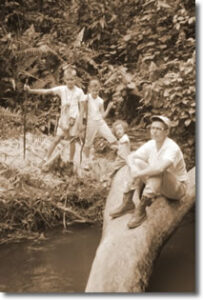 I did. And I’m happy to say, my own experience was nothing like The Poisonwood Bible. My father worked for fifty years as a physician dedicated to medically underserved populations. Mostly he practiced in rural Kentucky, but occasionally he took our family to live in other places, where “medically underserved” is an understatement. We spent 1963 in a Congolese village where most residents had never experienced electricity or plumbing, let alone western medical care. I was seven years old when we went. My parents were not missionaries, though we met some missionary families and benefited from their generosity on many occasions.